Architecture-Based Cloud Cost Estimator

Cloud Cost Estimator

Estimate cloud infrastructure costs automatically using architecture-based analysis across AWS, Azure, and Google Cloud.

Select Cloud Provider & Location

Choose the cloud provider where your infrastructure will run.

Pricing varies significantly by region. Select the region closest to your users.

Deploy resources across multiple availability zones for redundancy. This roughly doubles compute, database, and cache costs.

Multi-Cloud Cost Estimator: Compare AWS, Azure, & GCP Pricing

Planning a cloud migration or launching a new application? Accurately forecasting your cloud infrastructure costs is critical. Our Cloud Cost Estimator provides a comprehensive, architecture-based comparison across the top three public cloud providers: Amazon Web Services (AWS), Microsoft Azure, and Google Cloud Platform (GCP).

Why Use an Architecture-Based Cloud Calculator?

Traditional cloud pricing calculators require you to know exactly which instance types (e.g., t3.medium vs. D2s_v3) you need. Our AI-driven semantic estimator simplifies this by allowing you to select your application architecture (like Microservices, Serverless API, or High-Traffic Web App) and automatically mapping the required compute, storage, database, and networking resources to the closest matching services in AWS, Azure, and GCP.

Key Factors Influencing Cloud Infrastructure Costs

  • Compute Instances: Virtual machines (EC2, Azure VMs, Compute Engine) form the bulk of cloud expenses. Choosing between General Purpose, Memory Optimized, or GPU instances drastically affects your monthly bill.
  • Managed Databases: Relational databases (RDS, Cloud SQL) and NoSQL databases (DynamoDB, Cosmos DB) have varying pricing models based on storage, IOPS, and high availability (Multi-AZ) configurations.
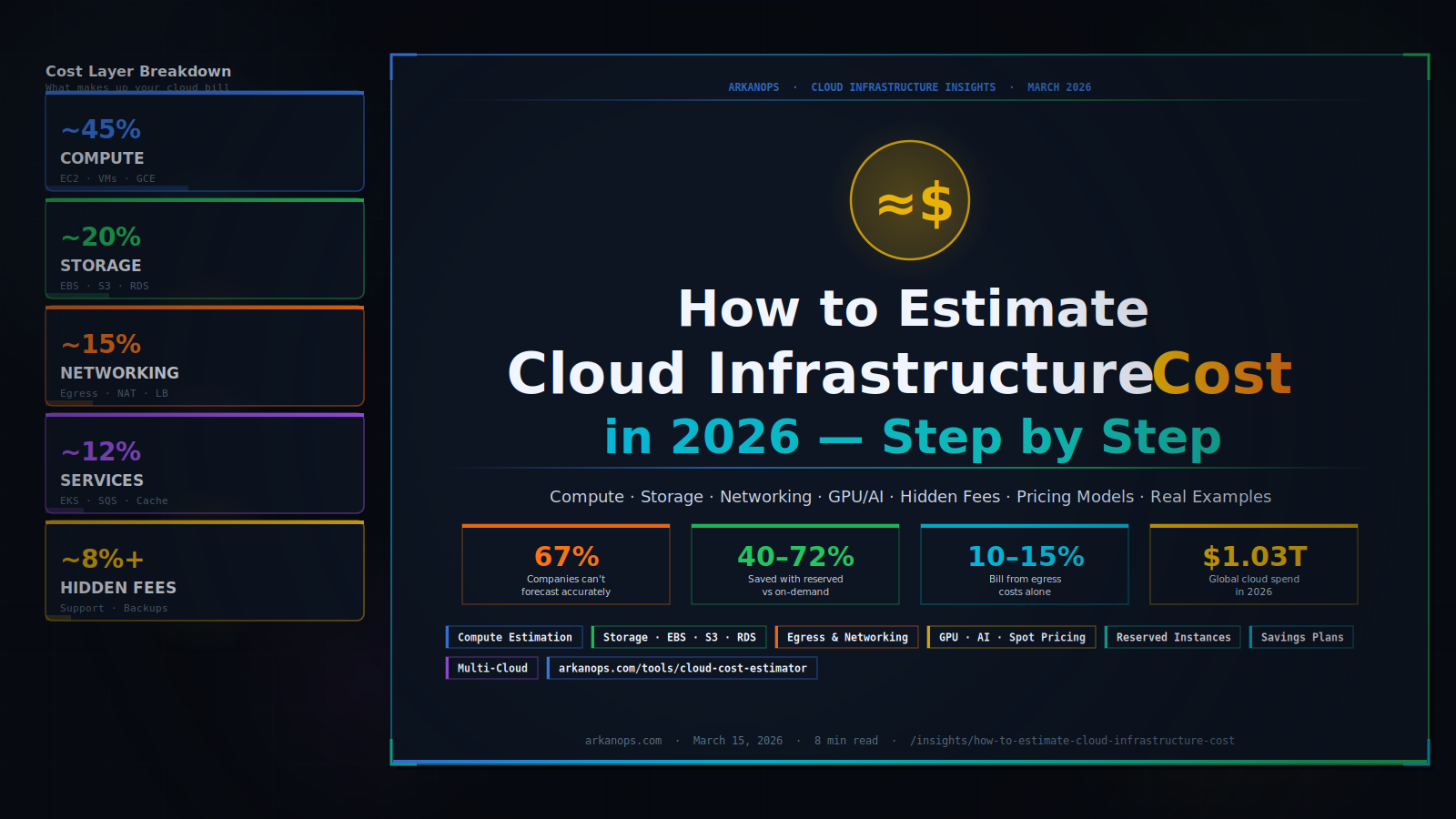
  • Data Transfer & Networking: Egress (data out) costs, Load Balancers, and CDN traffic can create hidden surprises in your cloud bill.
  • Serverless & Managed Services: Leveraging Kubernetes (EKS, AKS, GKE) or serverless functions (Lambda, Azure Functions) shifts costs from fixed hourly rates to consumption-based models.

Cloud Cost Optimization Best Practices

To achieve the best ROI on your cloud investment, consider these optimization strategies:

  1. Right-sizing: Continuously monitor CPU and memory utilization to downgrade over-provisioned resources.
  2. Reserved Instances & Savings Plans: Commit to 1-year or 3-year terms for predictable workloads to save up to 72% compared to on-demand pricing.
  3. Multi-Zone vs. Single-Zone: While Multi-Zone High Availability is essential for production, development and staging environments can run in a single zone to cut costs in half.

Use Cases

  • Cloud Migration Planning: Estimate the monthly costs of moving your on-premise infrastructure to AWS, GCP, or Azure.
  • Budget Forecasting: Generate accurate cost projections for upcoming projects to secure budget approvals.
  • Cost Optimization: Identify potential areas for cost savings by comparing different cloud providers and instance types.

Frequently Asked Questions

Which cloud providers are supported?

The estimator currently supports AWS, Google Cloud Platform (GCP), and Microsoft Azure.

Are the prices up-to-date?

We regularly update our pricing models to reflect the latest public pricing from major cloud providers.

Does it include data transfer costs?

Yes, the AI factors in estimated data transfer, storage, and compute costs based on your architecture.
Recommended Insights