FinOps Guide 2026: Stop Wasting Cloud Budget Right Now
Your cloud bill grows every month. Your team ships faster. But do you actually know where the money goes? Most companies waste nearly a third of their cloud spend without realizing it. FinOps fixes that — and in 2026, it has become a board-level priority. Here is everything you need to know. FinOps 2026 — […]
Your cloud bill grows every month. Your team ships faster. But do you actually know where the money goes? Most companies waste nearly a third of their cloud spend without realizing it. FinOps fixes that — and in 2026, it has become a board-level priority. Here is everything you need to know.
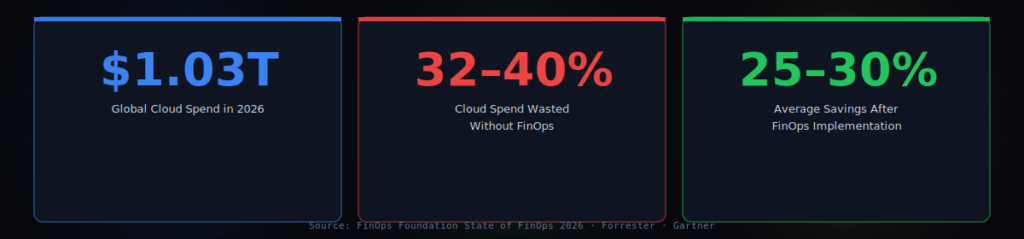
FinOps 2026 — Key numbers: global cloud spend, waste baseline, and average savings after FinOps adoption. Source: FinOps Foundation State of FinOps 2026, Forrester, Gartner.
Here is a number that should stop you in your tracks. Global cloud infrastructure spending will hit $1.03 trillion in 2026.
And according to the FinOps Foundation, organizations without a structured FinOps program waste between 32% and 40% of that spend on idle resources, over-provisioned machines, and storage that nobody uses.
For a company with a $10 million annual cloud bill, that is up to $4 million going straight in the bin.
FinOps is the practice that stops it — and in 2026, it has moved from a niche engineering concern to a core business discipline that reports directly to the CTO or CIO.
What Is FinOps? (The Simple Explanation)
FinOps stands for Cloud Financial Operations. It is the practice of bringing engineering, finance, and operations teams together to manage cloud spending with the same discipline they apply to any other major cost line.
Think of it this way. DevOps transformed software delivery from a slow, siloed handoff into a fast, continuous team sport.
FinOps does the same thing for cloud costs. Instead of finance sending a monthly bill that engineers ignore, every team owns their spend, sees it in real time, and acts on it continuously.
FinOps is no longer just a cost-reducing measure. It is how technology investments get planned, governed, and valued across the entire organisation. — State of FinOps 2026 Report, FinOps Foundation
In 2026, 78% of FinOps practices now report into the CTO or CIO organisation — up 18% versus 2023. That tells you everything. This is no longer an accounting exercise. It is a technology capability tied directly to architecture, engineering, and platform decisions.
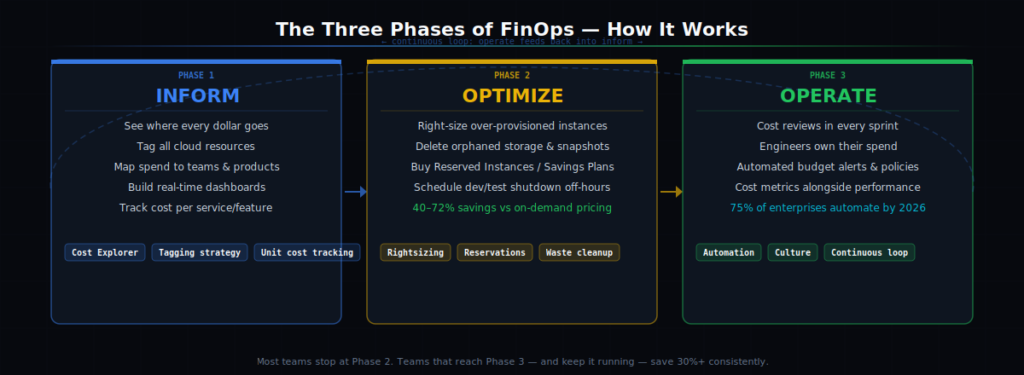
The FinOps lifecycle: Inform → Optimize → Operate. Each phase builds on the last — visibility enables action, and action feeds back into better forecasting.
The Three Phases of FinOps — and What You Do in Each One
Every mature FinOps programme runs through three phases — continuously, not once. Most teams start in Inform, struggle to get to Optimize, and rarely reach Operate. The ones that reach Operate are the ones saving 30% or more on their cloud bill.
Phase 1 — Inform: See Exactly Where Your Money Goes
You cannot cut what you cannot see. The Inform phase builds the visibility foundation. You tag every resource, map every cost to a team or product, and build dashboards that show real-time spend.
Only 43% of organisations currently track cloud costs at the unit level — meaning most companies cannot tell you whether a specific product or feature is actually profitable in the cloud. Inform closes that gap.
Phase 2 — Optimize: Cut Waste and Buy Smarter
Once you can see the spend, you start eliminating it. Right-size over-provisioned instances. Delete orphaned storage volumes. Schedule non-production environments to shut down at night.
Buy Reserved Instances or Savings Plans for steady, predictable workloads. Reserved instances and Savings Plans deliver 40–72% savings versus on-demand pricing — but only when you have enough visibility to commit confidently.
Phase 3 — Operate: Make Cost Awareness Part of Daily Work
The Operate phase is where FinOps becomes a culture, not a project. Engineers see cost metrics in their CI/CD dashboards.
Budget alerts fire before overruns happen. Cost reviews sit alongside reliability and security reviews in every sprint. FinOps automation will become standard practice for 75% of enterprises by 2026 — because manual cost management simply cannot keep up with cloud’s pace of change.
💡 Quick Win — Start Here This Week
- Turn on cost allocation tags across every AWS, Azure, or GCP resource today
- Set up a daily spend anomaly alert — a 20% spike overnight usually means something is wrong
- Identify your top 5 biggest cost lines — typically compute, data transfer, and storage
- Schedule dev/test environments to shut down outside business hours — saves 10–20% instantly
Where Your Cloud Money Actually Goes (The Waste Map)
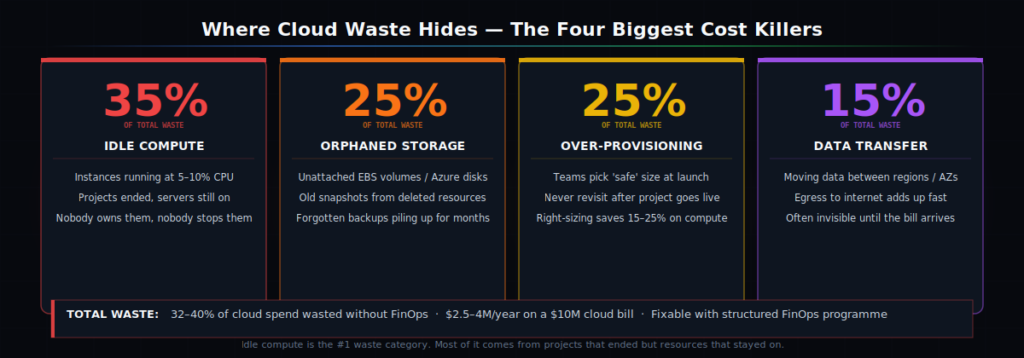
Where cloud waste hides in 2026 — the four main waste categories and how much each typically costs a $10M/year cloud customer.
Studies consistently show that organisations waste 25–35% of their cloud spend on idle resources, over-provisioned instances, and orphaned storage. But not all waste looks the same. The biggest culprits in 2026 are:
🚨 The Four Biggest Sources of Cloud Waste
- Idle and underutilised compute — instances running at 5–10% CPU that nobody switched off after a project ended. Accounts for roughly 35% of total waste.
- Orphaned storage — snapshots, unattached volumes, and old backup sets from resources that were deleted months ago. Easy to miss, expensive at scale.
- Over-provisioned instances — teams choose the “safe” instance size at launch and never revisit it. Right-sizing alone saves 15–25% on compute bills.
- Data transfer costs — moving data between regions, between services, or out to the internet. Often invisible until the bill arrives. Can be 10–15% of total spend.
The root cause of all four is structural. Engineering teams are incentivised to ship features fast, not to optimise cost.
When the person who provisions a resource does not own its cost, they have no reason to right-size it.
FinOps fixes this by giving engineers visibility into the financial consequences of their technical decisions — not to slow them down, but to help them make smarter choices at the start.
AI Is Your Biggest New Cloud Cost — Here Is How to Manage It
Every FinOps team in 2026 is wrestling with the same new problem: AI spend. GPU-intensive AI workloads now account for 18% of total cloud spend at AI-forward enterprises, up from just 4% in 2023. That is a 4.5× increase in three years, and the trajectory is not slowing down.
AI cost management is the single most desired skillset for FinOps teams across organisations of all sizes in 2026. The reason is complexity. A single LLM training run on a cluster of H100 GPUs can cost tens of thousands of dollars and complete in hours.
An inference endpoint left running with no traffic costs the same per hour whether it serves one request or one million. Traditional FinOps instincts — tag everything, right-size instances, buy reservations — all apply, but they need a new layer of discipline specific to AI workloads.
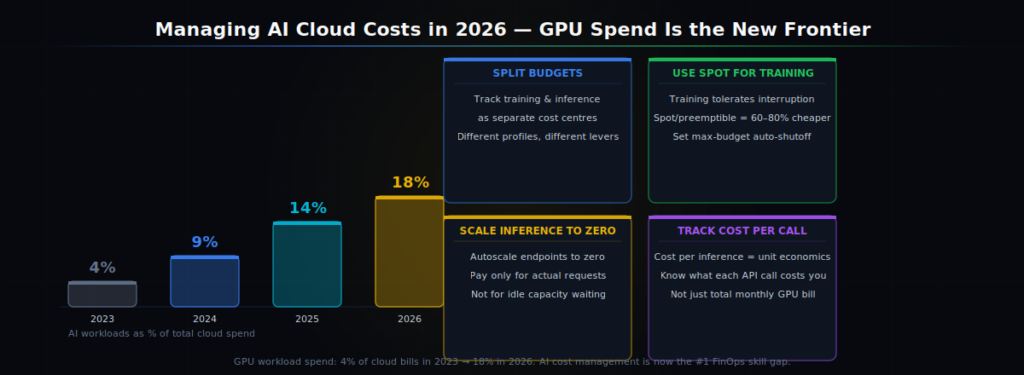
Managing AI cloud costs in 2026: separate training and inference budgets, use spot/preemptible GPUs for training, and set per-experiment cost gates to prevent runaway spend.
⚡ How to Control AI Cloud Costs in 2026
- Separate training and inference spend — track them as distinct cost centres with separate budgets and alerts
- Use spot/preemptible GPU instances for training — training jobs tolerate interruption; spot pricing saves 60–80% vs on-demand
- Set per-experiment cost limits — automated shutoff when a training run hits its budget cap prevents runaway jobs
- Right-size inference endpoints — use autoscaling with scale-to-zero for low-traffic models so you pay for actual requests, not idle capacity
- Track cost per inference call — unit economics for AI: know what each API call actually costs you, not just the total bill
Managing Multi-Cloud Costs — One View Across All Providers
76% of enterprises now operate across two or more cloud providers, making unified cost visibility the top FinOps challenge in 2026.
AWS, Azure, and GCP each have their own billing formats, discount mechanisms, and usage terminology. Comparing them manually is a full-time job that never produces reliable numbers.
The answer the industry has converged on is the FOCUS specification (FinOps Open Cost and Usage Specification).
FOCUS became generally available in June 2024 with one goal: standardise cost and usage data so teams can report and allocate spend consistently across different vendors and environments.
With FOCUS, you get a single normalised dataset that works for AWS reserved instances, Azure commitments, GCP committed use discounts, and SaaS subscription costs — all in the same report.
🔧 The 2026 Multi-Cloud FinOps Toolchain
- FOCUS spec — normalises billing data across all cloud and SaaS providers
- OpenCost (CNCF project) — open-source Kubernetes-native cost allocation, free and vendor-neutral
- CloudZero / Apptio Cloudability — commercial platforms for unit cost analytics and business mapping
- AWS Cost Explorer / Azure Cost Management — native tools, good starting point for single-cloud teams
- Flexera One / nOps — multi-cloud visibility with automated savings recommendations and commitment management
- Infracost — shows cost impact of Terraform changes before they deploy, right in the pull request
Developer FinOps — Make Engineers Care About Cost
The biggest cultural shift in FinOps in 2026 is who does it. 52% of engineering leaders say the disconnect between FinOps and developers is leading to wasted spend on cloud infrastructure.
The answer is not more finance meetings — it is putting cost data directly in front of engineers in the tools they already use.
Developer-facing FinOps means a developer sees the estimated monthly cost of their pull request before they merge it.
It means cost dashboards live next to latency dashboards in the same observability platform. It means architects see cost projections alongside performance estimates when they choose between two infrastructure options.
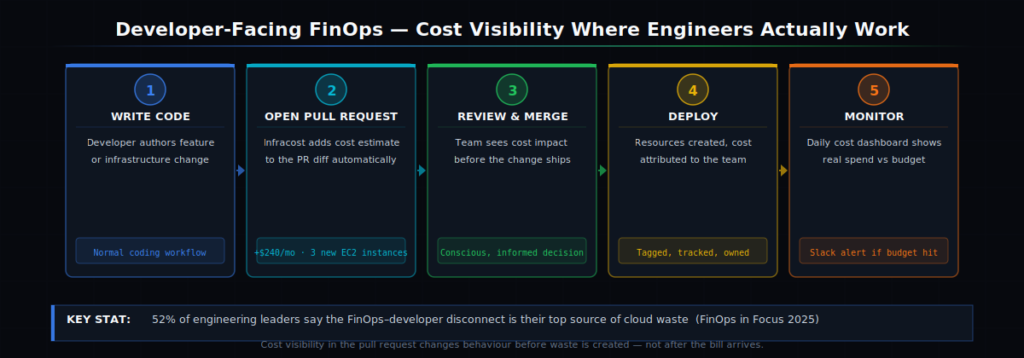
Developer-facing FinOps: cost visibility lands in the pull request, the CI pipeline, and the developer dashboard — so engineers can act on it before waste is created.
👩💻 How to Build Developer-Facing FinOps
- Add Infracost to your CI/CD pipeline — shows cost impact of every infrastructure change in the PR diff
- Give each team a cost dashboard — per-service, per-environment spend updated daily
- Set team-level budgets with Slack/Teams alerts — the team that owns the service gets the alert, not just finance
- Run monthly cost reviews per squad — 30 minutes, top 3 cost lines, one action item per session
- Make cost a hiring question — “how do you think about cloud cost when you design a feature?” tells you a lot
How to Start With FinOps Today — A 90-Day Plan
You do not need a dedicated FinOps team, a six-figure tooling budget, or an executive mandate to start. The teams that get results fastest start with the smallest possible scope and expand from there.
Days 1–30: Get Visibility
Enable cost allocation tags on every resource. Connect your cloud billing data to a dashboard — even a free one like AWS Cost Explorer or the Azure Cost Management portal. Identify your top 10 cost lines. Find anything that looks obviously idle or orphaned. Do not optimise yet. Just see.
Days 31–60: Find the Quick Wins
Delete orphaned resources. Schedule dev environments to shut down at night and weekends. Identify the five largest over-provisioned instances and right-size them. Buy Savings Plans or Reserved Instances for your most predictable compute workloads.
Companies report an average 25–30% reduction in monthly cloud spend after FinOps implementation, with some achieving 30% cuts within six weeks. Most of those savings come from exactly these steps.
Days 61–90: Build the Culture
Share what you found and what you saved. Run a cost review session with engineering leads. Add Infracost or a similar tool to your CI pipeline.
Assign a cost champion in each product team. Set quarterly cost targets per service. The goal is not to cut costs forever — it is to make every dollar you spend intentional and measurable.
★ Key Takeaways
Cloud waste is massive and fixable. Organisations without FinOps waste 32–40% of cloud spend. Mature FinOps programmes reduce this to 15–20% — a difference worth millions at scale.
FinOps runs in three phases. Inform (see where money goes), Optimize (cut waste and buy smarter), Operate (embed cost awareness into daily engineering culture). Most orgs stop at phase two.
AI spend is the new FinOps frontier. GPU workloads now make up 18% of cloud spend at AI-forward companies — up from 4% in 2023. Track training and inference separately and set per-experiment cost caps.
Use FOCUS to unify multi-cloud billing. 76% of enterprises run on two or more clouds. The FOCUS specification normalises billing data across AWS, Azure, GCP, and SaaS so you get one consistent view.
Put cost data in front of developers. 52% of engineering leaders say the FinOps–developer gap causes waste. Tools like Infracost show cost impact in the pull request, before waste is ever created.
Frequently Asked Questions
What is FinOps and why does it matter in 2026?
FinOps (Cloud Financial Operations) is the practice of managing cloud costs with engineering rigour — making spend visible, accountable, and continuously optimised. In 2026 it matters because global cloud spend is hitting $1 trillion, AI workloads are adding volatile GPU costs, and boards are demanding proof that cloud investment is disciplined before approving more capacity.
How much can FinOps save my organisation?
On average, teams report 25–30% reduction in monthly cloud spend after implementing FinOps, with some achieving 30% cuts in as little as six weeks. Quick wins like deleting orphaned resources, scheduling non-prod environments, and right-sizing instances typically deliver the fastest returns in the first 60 days.
Do I need a dedicated FinOps team?
Not to start. Many organisations begin with a single FinOps champion embedded in the platform or infrastructure team.
The FinOps Foundation’s 2026 survey shows that even at high spend levels, FinOps teams stay lean — they scale through automation and embedded cost champions in each product team, not through headcount.
What is the best FinOps tool for a small team?
Start with your cloud provider’s native tools — AWS Cost Explorer, Azure Cost Management, or GCP’s Cost Table.
They are free and cover the basics. Add Infracost to your CI/CD pipeline for pre-deploy cost estimates. Once you outgrow native tools, OpenCost (free, open-source) is excellent for Kubernetes cost allocation, and CloudZero or Apptio offer more advanced unit cost analytics.
Facing similar challenges?
Our team of architects can help you implement these patterns in your organization.
Schedule a Free Architecture ReviewRelated Articles
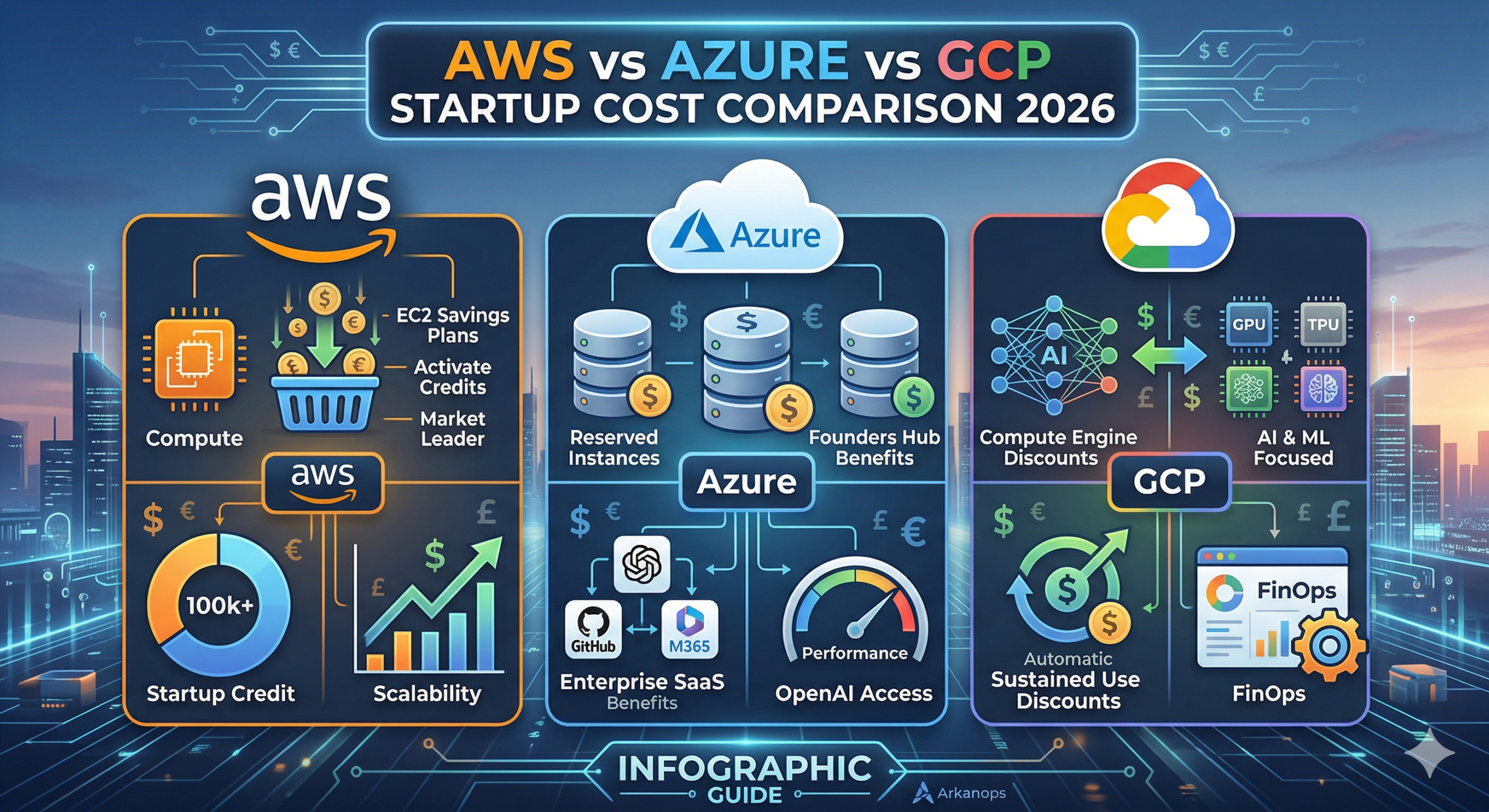
AWS vs Azure vs GCP: The Ultimate 2026 Startup Cost Comparison
For a tech startup in 2026, the cloud is no longer just “infrastructure.” It is the engine of your innovation. However, that engine can quickly consume your entire seed round if you don’t manage it properly. Amazon Web Services (AWS), Microsoft Azure, and Google Cloud Platform (GCP) have shifted their strategies this year. They are […]
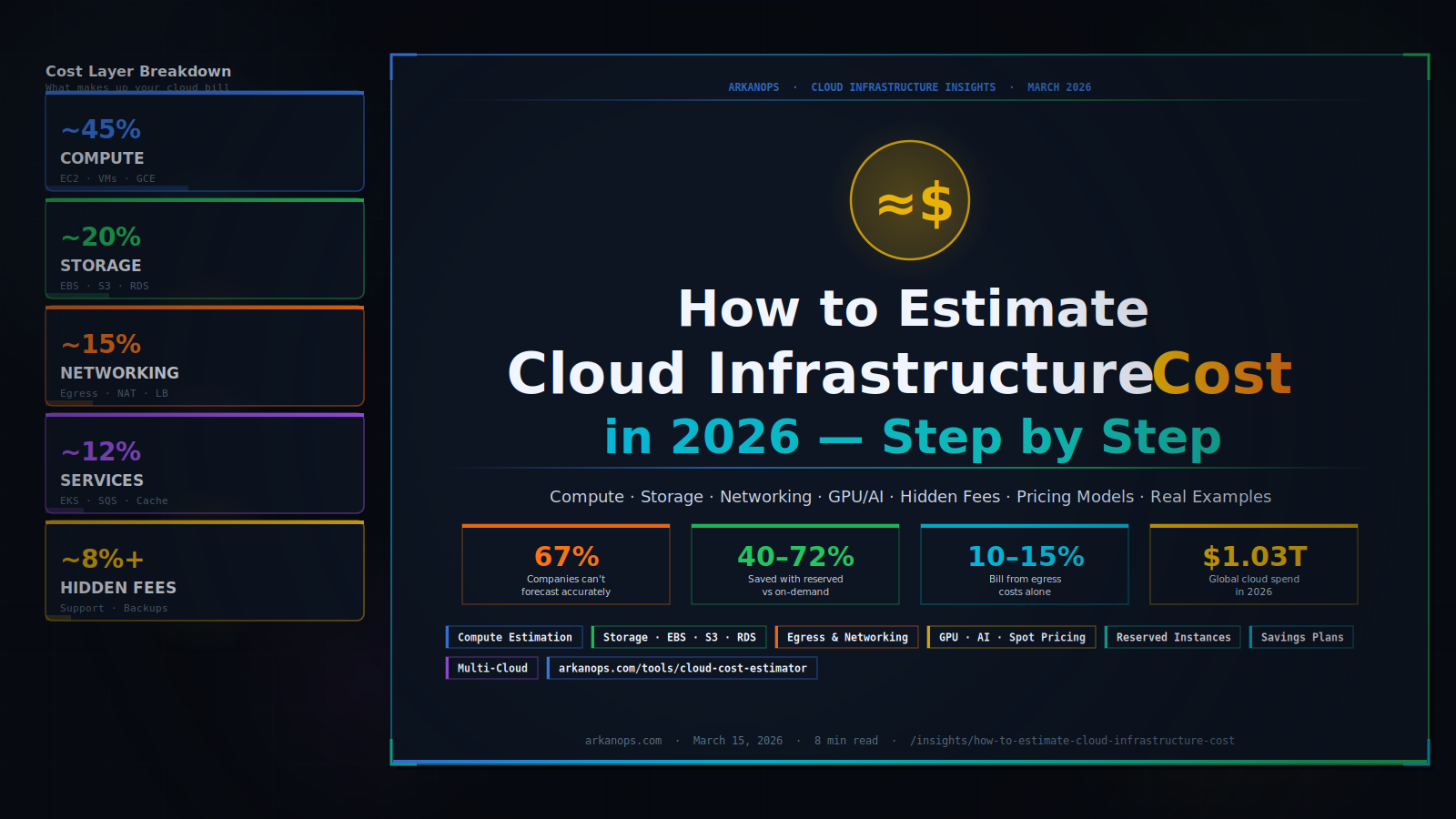
How to Estimate Cloud Infrastructure Cost in 2026
You are about to build something in the cloud — or you are already running something, and the bill keeps surprising you. Either way, you need a number you can trust. This guide shows you exactly how to estimate cloud infrastructure costs, layer by layer, without guesswork. Cloud infrastructure cost breaks into four main layers […]