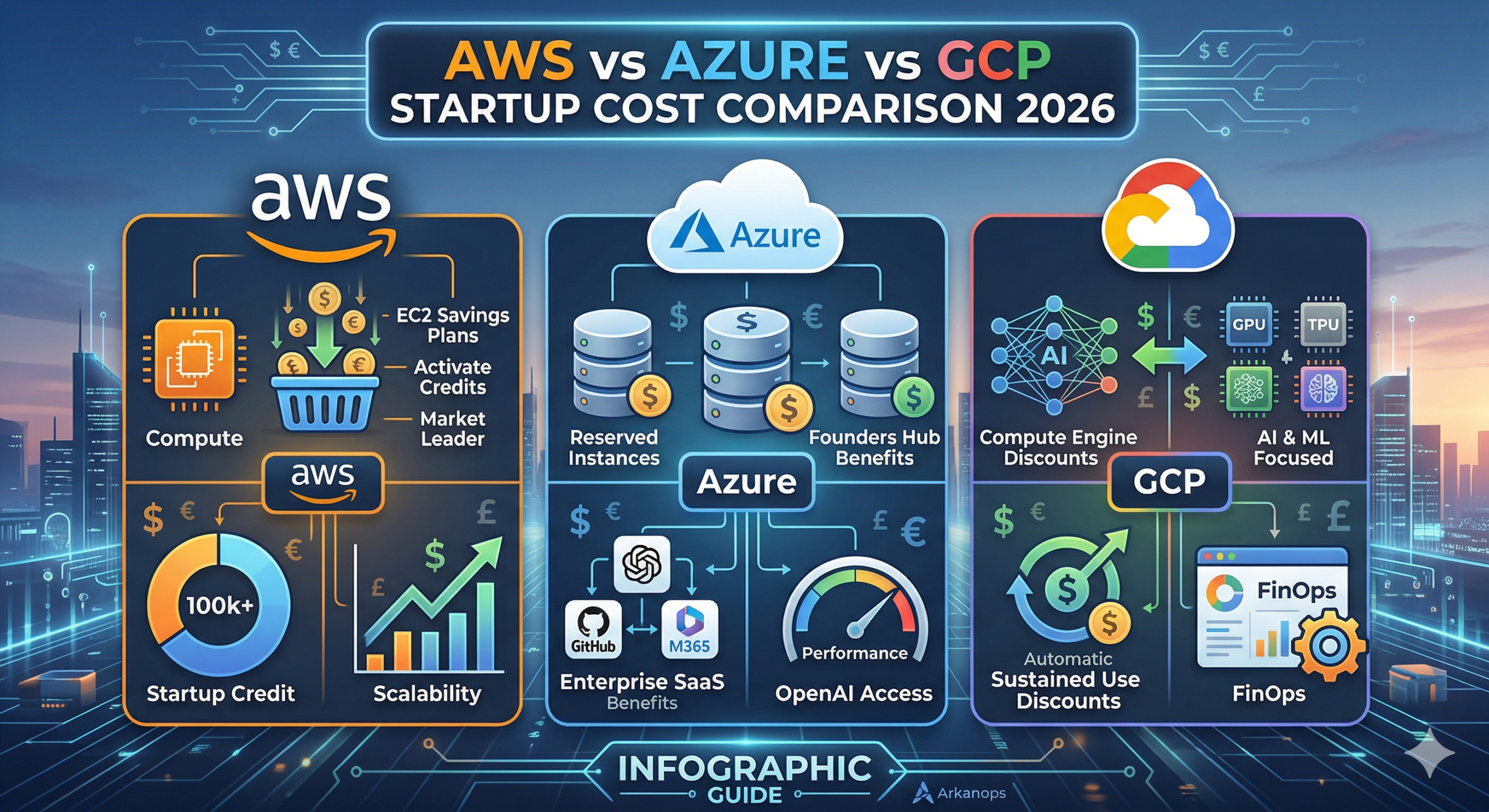
AWS vs Azure vs GCP: The Ultimate 2026 Startup Cost Comparison
For a tech startup in 2026, the cloud is no longer just “infrastructure.” It is the engine of your innovation. However, that engine can quickly consume your entire seed round if you don’t manage it properly. Amazon Web Services (AWS), Microsoft Azure, and Google Cloud Platform (GCP) have shifted their strategies this year. They are […]
For a tech startup in 2026, the cloud is no longer just “infrastructure.” It is the engine of your innovation. However, that engine can quickly consume your entire seed round if you don’t manage it properly.
Amazon Web Services (AWS), Microsoft Azure, and Google Cloud Platform (GCP) have shifted their strategies this year. They are no longer just fighting for market share; they are fighting to be the foundation of your AI models.
This guide provides a comprehensive cost comparison of the “Big Three” tailored for startup founders and CTOs. We will dive into credit programs, compute pricing, and the hidden “cloud taxes” that could sink your budget.
The 2026 Cloud Landscape: Why Cost Strategy is Vital
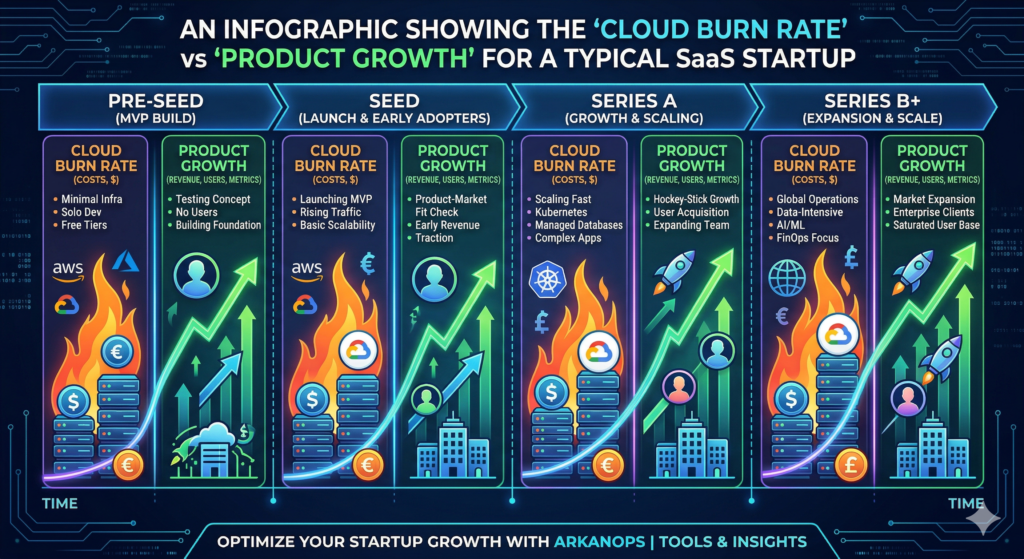
In the past, startups chose a cloud provider based on familiarity. Today, the choice is driven by FinOps—the practice of bringing financial accountability to the variable spend of the cloud.
Before committing, you need a clear picture of your trajectory. You can use the Arkanops Cloud Cost Estimator to simulate your monthly spend based on real-world traffic patterns.
1. Startup Credit Programs: The “Free” Money War
The first year of your startup’s life is often subsidized by cloud credits. In 2026, these programs will have become even more generous, especially for AI-focused companies.
AWS Activate: The Reliable Giant
AWS has updated its Activate program to include a specialized AI tier.
- Founders Tier: $1,000 in credits for bootstrapped startups.
- Portfolio Tier: Up to $100,000 for startups backed by VCs or accelerators.
- AI Frontier Tier (New for 2026): Up to $300,000 in credits specifically for startups training foundation models on AWS Trainium or Inferentia chips.
Microsoft for Startups Founders Hub: The Ecosystem Play
Microsoft continues to offer the best “bundle” value.
- Azure Credits: Up to $150,000 over two years.
- The AI Edge: Startups get direct, high-priority access to the Azure OpenAI Service.
- Free Software: This includes GitHub Enterprise, Microsoft 365, and LinkedIn Premium, which can save a 10-person startup over $15,000 annually in SaaS fees.
Google for Startups Cloud Program: The AI Leader
Google has the most aggressive credit limits in 2026 to capture the generative AI market.
- Standard Startup Credits: Up to $200,000 over two years.
- AI-First Startups: Up to $350,000 in credits.
- Unique Perk: Google now offers $10,000 in “Model Credits” for third-party LLMs like Anthropic (Claude) and Mistral running on GCP.
2. Compute Costs: Comparing Virtual Machines (VMs)
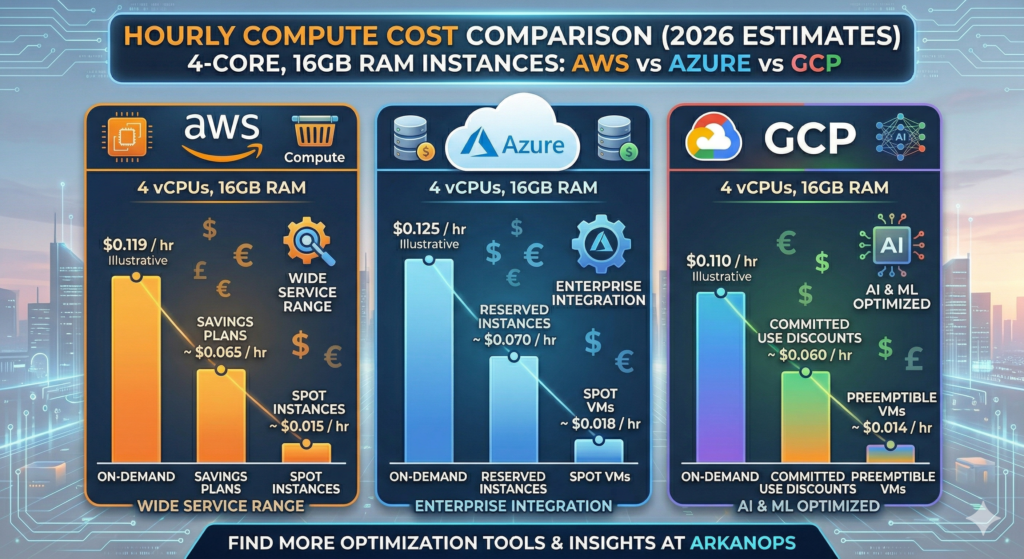
Compute is usually 50% to 70% of a startup’s bill. Each provider names their virtual servers differently:
- AWS: EC2 (Elastic Compute Cloud)
- Azure: Virtual Machines
- GCP: Compute Engine
Pricing Models in 2026
| Model | AWS | Azure | GCP |
| On-Demand | Most expensive, no commitment. | Competitive with AWS. | Often 5-10% cheaper than AWS. |
| Committed Use | Savings Plans (up to 72% off). | Reserved Instances (up to 72% off). | Committed Use Discounts (CUDs). |
| Preemptible/Spot | Up to 90% off. | Up to 90% off. | Up to 80-91% off (Very stable). |
GCP’s Sustained Use Discounts are a major win for startups. Unlike AWS or Azure, where you must sign a contract to get a discount, Google applies discounts automatically if you run a VM for more than 25% of a month.
If you are using Kubernetes to manage these servers, ensure you aren’t overspending. Use a Kubernetes Sizer to find the “sweet spot” for your node sizes.
3. Storage and the “Data Egress” Tax
Storage is cheap. Moving data is expensive. This is the “hidden tax” of the cloud.
Storage Tiers
All three providers offer “Hot,” “Cool,” and “Archive” storage tiers.
- Standard Storage: ~$0.021 – $0.023 per GB.
- Archive/Glacier: ~$0.00099 per GB (Best for long-term backups).
Data Egress Fees
In 2026, GCP and AWS have started waiving egress fees for customers moving out of their cloud to comply with new regulations. However, moving data between regions or to your users still carries a cost.
If your startup is building a data-heavy application, you should plan your architecture to minimize cross-region traffic. Use a System Design Generator to map out your data flow and spot expensive egress points.
4. Managed Services: Kubernetes and Databases
As a startup, you don’t have time to manage servers. You use “Managed Services” like EKS (AWS), AKS (Azure), or GKE (GCP).
- Kubernetes Management: AWS and GCP charge a flat fee of ~$73/month per cluster for the “management plane.” Azure offers a “Free” tier for management, but it lacks the high-availability SLA of their paid tier.
- Databases: Managed SQL and NoSQL databases are pricey. AWS Aurora and Google Cloud Spanner are premium products. For a cheaper start, consider using standard RDS or Cloud SQL instances with a Terraform Generator to automate your database lifecycle.
5. The AI Frontier: GPU and TPU Costs
In 2026, AI compute is the new gold.
- AWS: Focuses on custom chips like Trainium 2. These are significantly cheaper than Nvidia H100s if you can optimize your code for them.
- Azure: The go-to for Nvidia clusters. If you need raw GPU power and have a partnership with Microsoft, Azure is unbeatable.
- GCP: Their TPU v6 (Ironwood) offers the best performance-per-dollar for training large-scale models.
Startups often struggle with the cost of AI containers. Check out our insight on When Containers Met AI to learn how to optimize these workloads.
6. How to Optimize Costs from Day One
Don’t wait for a $5,000 bill to start caring about costs. Follow these three steps:
A. Infrastructure as Code (IaC)
Never create resources manually in the portal. It’s the fastest way to lose track of what you are paying for. Use a Terraform Generator to keep your environment predictable. If you are using Docker, use a Docker Builder to create lean images that use less storage and bandwidth.
B. Constant Analysis
Cloud providers release new, cheaper instance types every few months. Use an Architecture Analyzer to see if your current setup is outdated or overpriced.
C. Shift Security Left
A security breach is a financial disaster. A hacked account can spin up hundreds of expensive GPUs in minutes. Follow a DevSecOps Security as Code Guide to implement budget alerts and IAM restrictions that protect your wallet.
7. Strategic Comparison: Which One Should You Pick?
Choose AWS if:
- You need the largest ecosystem of third-party tools.
- Your team is already “AWS Certified.”
- You want the highest number of edge locations for low-latency apps.
Choose Azure if:
- You are a B2B startup selling to big enterprises (they love Azure).
- You are heavily integrated with Microsoft 365 or GitHub.
- You need specialized access to OpenAI’s latest models.
Choose GCP if:
- You are building data-intensive or AI-first products.
- You want the best Kubernetes experience (GKE is still king).
- You prefer a simple, developer-friendly interface and automatic discounts.
Detailed Cost Estimation Example (2026 Pricing)
Let’s look at a typical “Growth Stage” startup setup:
- Compute: 10 VMs (4 vCPU, 16GB RAM)
- Storage: 5TB Standard Object Storage
- Database: Managed PostgreSQL (2 nodes)
- Networking: 1TB Egress
Estimated Monthly Spend (Before Credits):
- AWS: ~$2,450
- GCP: ~$2,180 (Assuming Sustained Use)
- Azure: ~$2,320
Note: These are estimates. Use our How to Estimate Cloud Infrastructure Cost guide for a deeper breakdown.
8. Avoiding the “Locked-In” Trap
Cloud providers want you to stay forever. They make it easy to get in and hard to leave. To maintain flexibility:
- Use Containers: Pack your apps with a Docker Builder.
- Standardize Configs: Use our JSON-YAML Converter and Kubernetes YAML Builder to ensure your deployment files are portable.
- Automate Pipelines: Set up a CI/CD Generator that can deploy to any cloud with minimal changes.
FAQs: AWS vs Azure vs GCP Startup Costs
1. Which cloud provider is the cheapest for startups in 2026?
Overall, GCP tends to be the cheapest for on-demand and AI-heavy workloads due to automatic discounts. However, Azure can be cheaper if you factor in the value of the free Microsoft 365 and GitHub licenses.
2. Do cloud credits apply to AI models?
Yes. AWS credits apply to models on Amazon Bedrock. Azure credits apply to OpenAI services. GCP credits apply to Vertex AI and Gemini models.
3. How do I stop my cloud bill from exploding?
Implement FinOps early. Set up budget alerts at 25%, 50%, and 75% of your expected spend. Use an Architecture Analyzer to find and delete unused resources.
4. Is the AWS “Free Tier” actually free?
Only for the first 12 months, and only for specific, low-power resources. After 12 months, many of those “free” services start billing you automatically.
5. Can I use credits from two different providers?
Usually, yes. Many startups use a “Multi-Cloud” approach where they use AWS for their core app and GCP for their big data analytics to maximize free credits from both.
Conclusion: The Smart Founder’s Move
Cost should not be the only factor in your decision, but it is a major one. In 2026, the real winner is the founder who builds a portable and automated infrastructure.
By using tools like the Arkanops Terraform Generator and FinOps Guide, you can ensure that your startup remains lean, agile, and ready to scale regardless of which cloud giant you choose.
Start your journey right: Build your first deployment manifest with our Kubernetes YAML Builder today!
Facing similar challenges?
Our team of architects can help you implement these patterns in your organization.
Schedule a Free Architecture ReviewRelated Articles
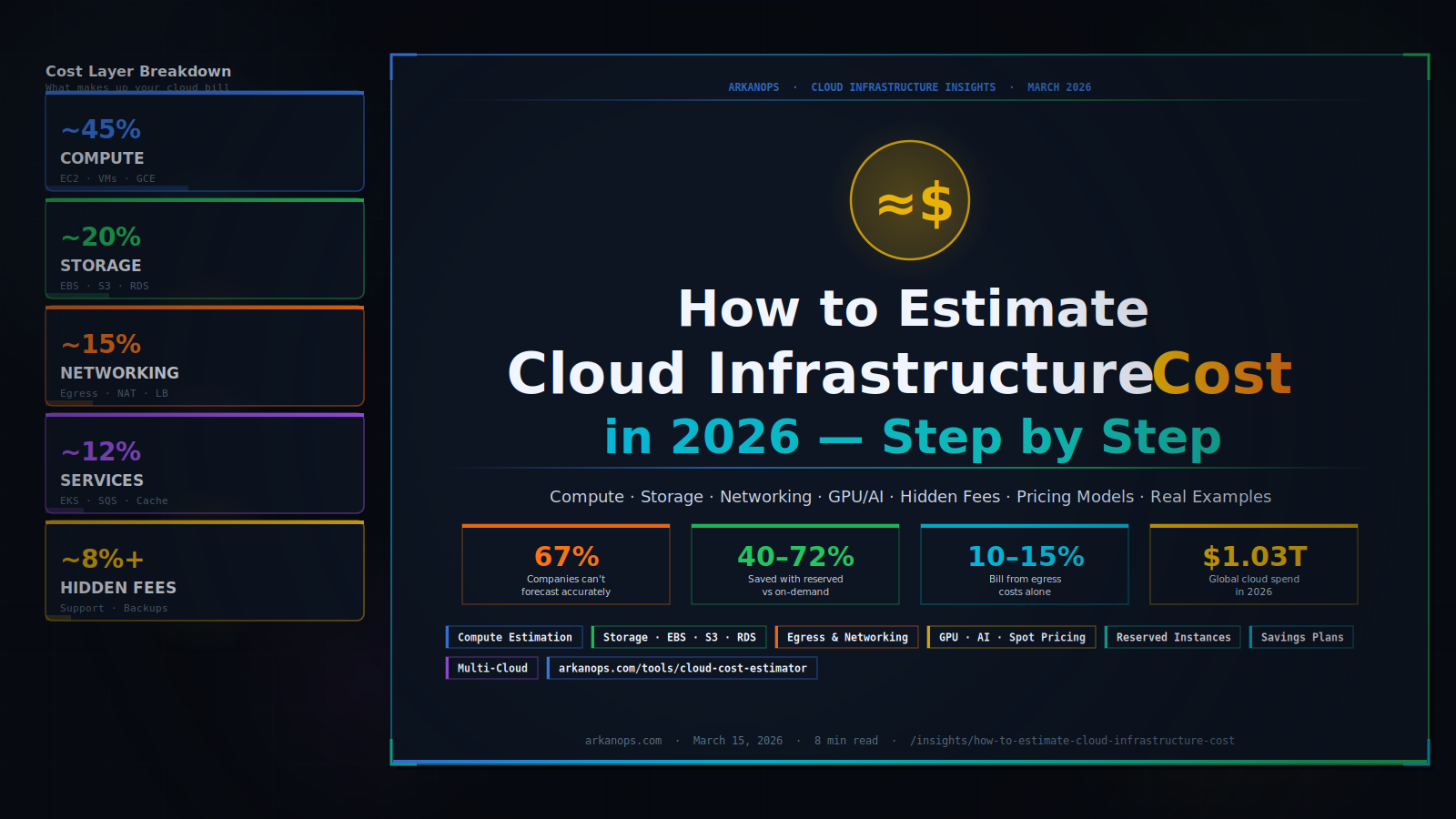
How to Estimate Cloud Infrastructure Cost in 2026
You are about to build something in the cloud — or you are already running something, and the bill keeps surprising you. Either way, you need a number you can trust. This guide shows you exactly how to estimate cloud infrastructure costs, layer by layer, without guesswork. Cloud infrastructure cost breaks into four main layers […]
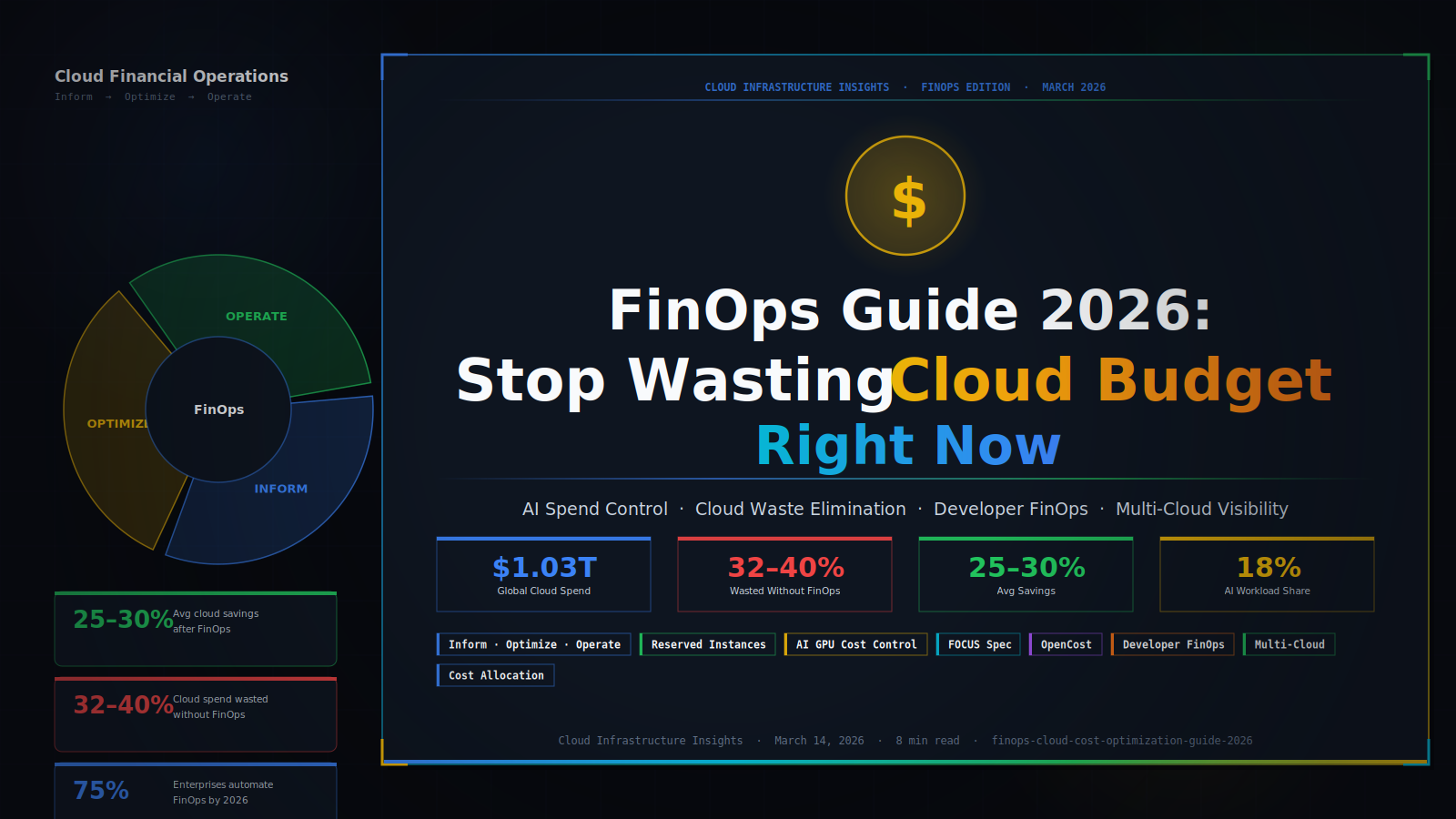
FinOps Guide 2026: Stop Wasting Cloud Budget Right Now
Your cloud bill grows every month. Your team ships faster. But do you actually know where the money goes? Most companies waste nearly a third of their cloud spend without realizing it. FinOps fixes that — and in 2026, it has become a board-level priority. Here is everything you need to know. FinOps 2026 — […]